
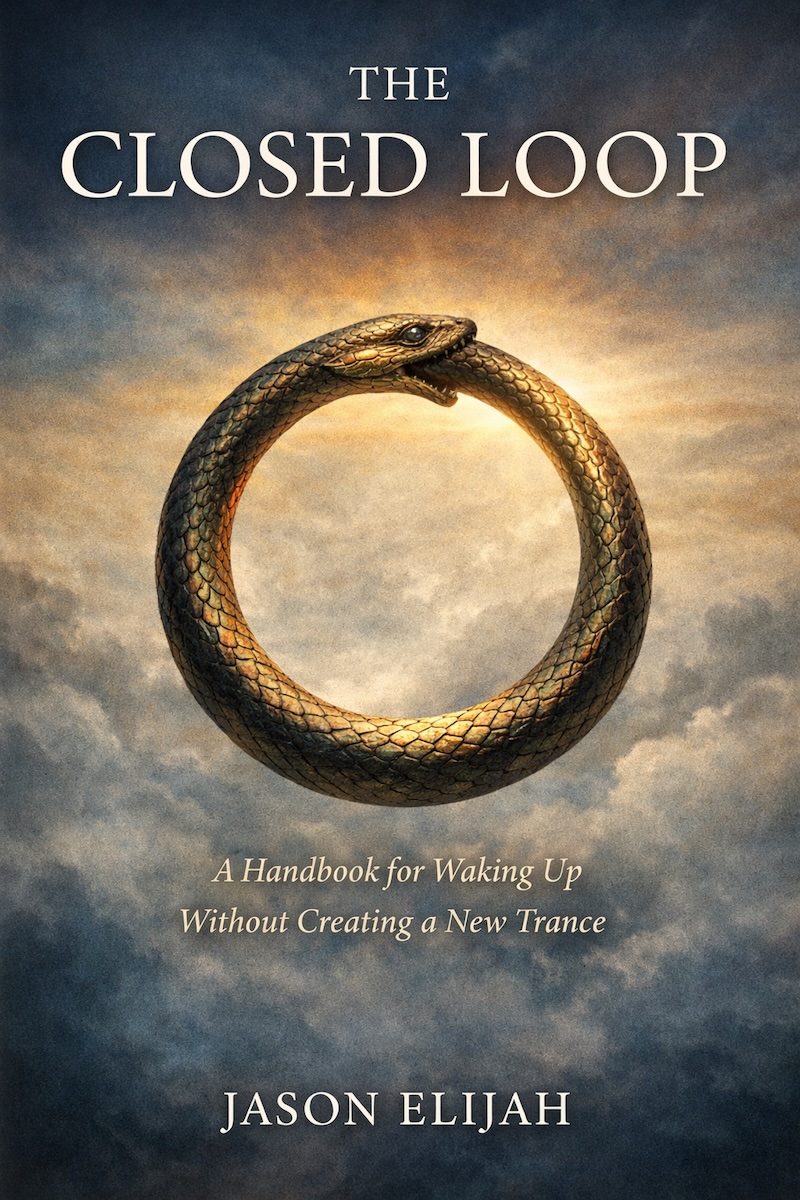
Threshold Eight · Entrapment
The Closed Loop
A Handbook for Waking Up without Creating a New Trance
A mind under pressure can mistake coherence for contact.Available on Amazon ↗
About the book
The Closed Loop begins with a recognition that is both unsettling and strangely familiar: most false realities do not begin with lies. They begin with relief. A story lands. The body unclenches. Confusion narrows into coherence. What felt uncertain a moment ago suddenly feels organized, meaningful, and strangely solid. The problem is not that meaning appears. The problem begins when the feeling of coherence starts to matter more than reality itself.
This book explores how that shift happens. It follows the ordinary human mechanisms through which pressure turns into over-meaning, attention becomes fuel, and explanations begin referring inward instead of outward. What emerges is not a portrait of irrational people or moral failure, but of a deeply human system trying to regulate itself under strain. The loop does not begin with madness. It begins with a nervous system trying to settle.
Because of this, The Closed Loop does not treat closed belief as a type of person, a political camp, or a spiritual flaw. It treats it as a mechanism that can appear anywhere: in private thought, in intimate relationships, in online culture, in institutions, in media systems, in ideologies of every kind. The content changes. The structure does not. A feeling becomes proof. A conclusion becomes evidence. Doubt begins to feel like threat. Meaning starts to harden.
From there, the book moves outward in widening circles. It traces how loops are sustained through captured attention, intermittent reinforcement, and the exhausting pull of almost-clarity. It shows how ambiguity can become adhesive, how confusion can be exploited by people who benefit from holding others slightly off balance, and why trying to “call it out” too early often hardens the very structure one hopes to loosen. The book is careful here. It does not hunt villains. It names dynamics. It asks what is being stabilized, and at what cost.
As the lens widens further, the loop becomes social. Groups begin to borrow stability from shared narratives. Agreement settles the body. Belonging starts to depend on coherence. Media systems and platforms accelerate the same tendencies, not because they are secretly coordinating reality, but because they reward what holds attention. Suspicion, outrage, partial answers, endless commentary, the constant pressure of almost-knowing — all of it creates an environment in which loops become easier to enter and harder to notice.
Yet it does not stop with diagnosis. It turns, quietly, toward exit. Not a dramatic exit. Not the fantasy that truth arrives like lightning and breaks the spell forever. One of the book’s deepest insights is that truth often fails to save people while a loop is still holding things together. Facts address content. Loops address regulation. Until the body is safe enough to loosen, reality can feel cold, threatening, or unusable. This shifts the question from winning arguments to restoring conditions where revision becomes possible.
That is where the second half of the book breathes. It explores release from the loop not as triumph, but as anticlimax. The grip loosens. The urgency fades. Thoughts stop performing constantly. Life becomes more ordinary, more proportionate, less charged with the need to complete itself. What returns is not some heroic new identity, but contact: meals, sleep, humor, boredom, conversation, time, the quiet dignity of no longer needing every question to become a worldview.
By the end, The Closed Loop becomes an ethic as much as an analysis. It asks what it means to remain revisable in a meaning-hungry world. To let some things matter without giving them devotion. To stay human under pressure. To understand that sanity is not a permanent state, but a practice of return. Return to the body, return to ordinary contact, return to people who do not require alignment, return to reality before coherence hardens into a kind of trance.
What emerges is not a manual for permanent certainty, but something cleaner and more durable than that.
You do not need beliefs that feel airtight.
You need beliefs that can breathe.
Read an excerpt from this book
Chapter One
The Loop Before the Lie
The mistake most people make is thinking false beliefs begin with false information.
They do not.
They begin with a feeling.
Not fear exactly, and not ignorance. It is closer to pressure. A subtle tightening in the body. A sense that something important is happening, that clarity is close, that understanding will bring relief.
This is the moment the loop starts forming.
Before ideology.
Before delusion.
Before manipulation.
There is simply a nervous system trying to settle itself.
The Body Wants Coherence
The human mind is a pattern-making organ. It evolved to detect relationships, anticipate outcomes, and reduce uncertainty. This capacity is not abstract. It lives in the body.
When the world feels unstable, the body responds first.
Breathing becomes shallower. Attention narrows. Thoughts arrive more quickly than they can be evaluated. The mind begins scanning for signal. Anything that connects starts to stand out. Coincidences feel charged. Familiar details take on weight.
This is not pathology. It is adaptation.
When the environment is unpredictable, coherence feels like safety. A story that explains what is happening allows the body to unclench. Muscles soften. The jaw loosens. For a moment, the body rests.
That relief is real. And it matters.
Someone is navigating a period of uncertainty at work. Expectations change week to week. Feedback is vague. They never quite know whether they are doing well or falling behind.
One afternoon, a simple explanation lands. A story about office politics. A theory about why certain messages go unanswered.
Nothing has been proven. No new facts appear. But the body relaxes.
From that moment on, small details begin to align. A tone in an email. A look in a meeting. The story explains not just one moment, but many.
The relief does not come from truth. It comes from coherence.
The problem is not that the mind seeks coherence. The problem arises when coherence becomes more important than contact with reality.
When Meaning Stops Looking Outward
In a healthy mind, meaning is provisional. Explanations are tested against the world. Beliefs remain open to revision. Doubt is uncomfortable, but it is tolerated.
In an open mind, meaning points outward.
Under pressure, that orientation can shift.
Instead of testing ideas against reality, the mind begins testing reality against the idea. Information is no longer evaluated for accuracy, but for fit. The question quietly changes from “Is this true?” to “Does this support what already makes sense?”
When that happens, meaning begins to reference itself.
A conclusion becomes evidence.
A feeling becomes proof.
Resonance overrides verification.
At first, this feels like insight.
Then it feels like certainty.
Then it feels like threat when questioned.
The loop does not announce itself as a trap. It announces itself as coherence.
Someone trying to understand a confusing relationship begins to notice patterns. A comment made weeks ago suddenly feels significant. A silence now carries intention. Memories reorganize themselves around a single explanation.
When a friend suggests an alternative view, it feels irritating rather than informative. Not because the friend is wrong, but because the suggestion unsettles the story that has brought calm.
The mind does not ask whether the explanation is accurate. It asks whether it keeps the body steady.
Relief as Reinforcement
One reason closed loops are so difficult to recognize is that they feel stabilizing at the beginning.
The relief is not imagined. It is physiological. A story settles the body. The nervous system calms. Confusion gives way to order.
Each time the story explains something, the body rewards it. Each time a new detail fits, the sense of rightness grows stronger. The mind learns quickly.
This works.
Over time, the loop becomes self-reinforcing. The story generates relief. The relief strengthens the story. Information that supports it feels grounding. Information that challenges it feels disruptive, regardless of its truth.
This is not stubbornness. It is regulation.
The loop is doing what it learned to do. It is keeping the body calm.
A person scrolling late at night encounters an explanation for something that has been bothering them. A thread. A post. A comment that ties loose ends together.
They feel a small release. They keep reading.
Each related post reinforces the same frame. Each contradiction feels poorly informed. The longer they stay, the steadier they feel.
The loop does not demand belief. It rewards attention.
What a Closed Loop Feels Like
This matters more than definitions.
A closed loop feels clarifying.
It feels focused.
It feels like finally being oriented after confusion.
People inside a loop are often not anxious in the way we expect. They may appear calm, energized, even generous. They may feel compassion for those who do not see what now seems obvious. They may feel patient rather than panicked.
This is why arguing facts rarely works. Facts are not evaluated on their own terms. They are filtered through the loop.
What keeps the loop intact is not deception. It is reinforcement.
Each confirming detail tightens the structure.
Each unanswered question pulls attention back in.
Each challenge increases the sense that something important is at stake.
The loop feeds on engagement.
The Ouroboros Is a Loop
The ancient image of the serpent eating its own tail survives because it describes a mechanism, not a myth.
A loop that consumes its own outputs as inputs does not require an external enemy. It sustains itself.
Once formed, a closed loop does not need someone to lie to it. It does not need a villain. It runs on its own momentum.
That is why the same structure appears across radically different contexts.
In political movements.
In online subcultures.
In abusive relationships.
In spiritual communities.
In personal crises.
The content changes. The mechanism does not.
The danger is not what people believe.
The danger is when belief stops being revisable.
How the Shift Happens
There is no single moment when a person falls into a closed loop.
There is only a gradual narrowing.
A little less tolerance for ambiguity.
A little more urgency.
A growing preference for explanations that arrive quickly.
A quiet impatience with what complicates the story.
None of this feels extreme. It feels responsible.
It feels like paying attention.
It feels like taking things seriously.
It feels like protecting oneself from confusion.
Someone stops asking open questions and starts asking leading ones. They no longer wonder what else might be true. They wonder why others cannot see what seems clear.
Nothing dramatic has happened. No belief has been declared. But the range of possible meanings has quietly collapsed.
That is why closed loops are so common, and why they are often missed until they harden.
By the time the loop is visible, it often feels too costly to leave. Leaving may threaten identity, belonging, or the sense of having finally understood something that once felt overwhelming.
A Necessary Caution
If at any point while reading this book you feel a growing sense that it explains everything, pause.
If you notice yourself tracking who needs this more than you do, pause.
If relief begins to replace curiosity, pause.
These are not signs of clarity. They are signs of closure.
This book will not save you from that tendency. Nothing can.
What it can offer is something quieter and more durable.
A way to notice the tightening earlier.
A way to loosen without tearing.
A way to remain in contact with reality even when coherence feels comforting.
The world you return to may feel less tidy. It may offer fewer answers. It may ask more patience than certainty ever did.
But it will be real.
That is where contact lives.
And that is where this book begins.