Threshold Five · Perception
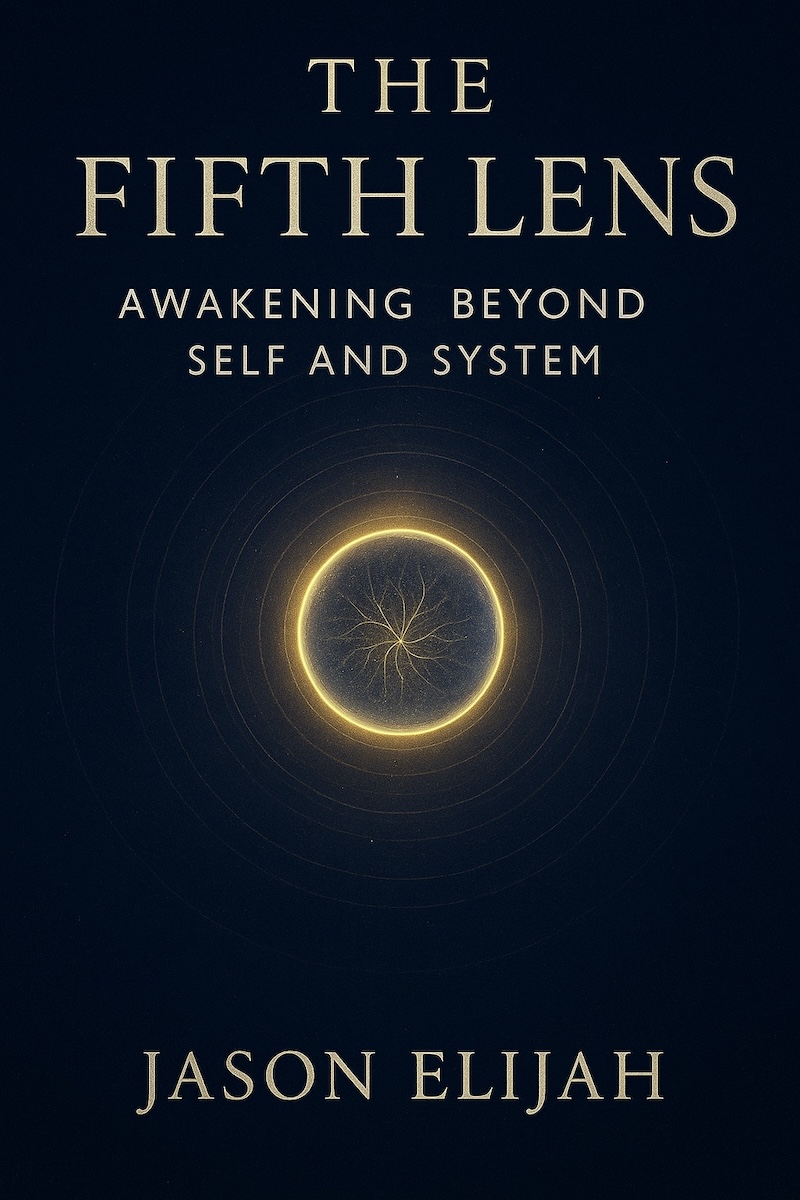
The Fifth Lens
Awakening Beyond Self and System
Every era sees through a lens it mistakes for reality.Available on Amazon ↗
About the book
The Fifth Lens begins with a simple but destabilizing recognition: human beings do not see reality directly. We see through inherited lenses — ways of perceiving shaped by myth, reason, psychology, culture, and systems of power, so familiar they disappear into the background. What feels like reality is often a way of seeing that has gone unquestioned for so long that it becomes invisible.
This book explores what happens when those inherited lenses begin to crack. It traces the major movements of human perception — the Mythic Lens, the Rational Lens, the Psychological Lens, and the Systemic Lens — as evolving ways of seeing reality. Each lens expanded human understanding. Each also introduced new blind spots. The problem is not that these lenses were wrong, but that each eventually came to be mistaken for reality itself.
From there, The Fifth Lens turns toward the possibility of a wider and more integrated way of seeing, grounded in inter-being, relationship, and participation in a living whole.
The book begins by making the old lens visible, the unnoticed structures through which self, world, and other have been divided. It then follows the consequences of separation through identity, culture, technology, politics, and ecology. Many of the crises of modern life are not simply failures of information, policy, or technology. They are failures of perception. A civilization cannot solve problems it cannot properly see.
At the center of the book is the Fifth Lens itself — a way of seeing that emerges when the limitations of previous lenses become visible. It does not reject myth, reason, psychology, or systems thinking. It integrates them. What emerges is a perception capable of recognizing relationship, participation, and inter-being without losing the truths discovered by earlier ways of seeing. The self is no longer an isolated unit. Other people are no longer fundamentally outside us. Earth is no longer just a backdrop or a resource. Society, psyche, body, spirit, and world are seen as inseparable parts of the same living system, each shaping and being shaped by the others.
Inter-being is treated as a structural reality. Breath is shared. Wounds shape more than one life. Healing does too. The nervous system of an individual reflects the nervous system of a family, a culture, a species. The mirrors are everywhere. The web is already breathing. To awaken is not to invent connection, but to recognize that separation was never the whole truth.
From that recognition, the book explores what it means to live from this wider sight — in relationship, in healing, in ritual, in technology, in governance, in ecology, and in the future of identity. The question is no longer simply what is true, but how a person might live once truth is seen relationally instead of separately.
The Fifth Lens is not only a book about perception. It is a book about remembrance. It suggests that the future will not come through more fragmentation, conquest, or control, but through a deeper remembering: that life is woven, and that we have never truly been separate from what sustains us.
What emerges is a vision that is spiritual, psychological, ecological, and civilizational. Not a rejection of earlier lenses, but their integration, and a truer entry into the world.
The lens does not create a new reality.
It reveals the one we were always standing inside.
Read an excerpt from this book
Chapter One
The Glass We Never See
We do not notice the glass until it breaks.
A window so flawless we forget it is there, a lens so constant we mistake it for reality itself.
Only when it fractures, when the light splinters and the edges cut, do we realize we have been looking through something all along.
Humanity has always gazed through glass.
Not panes of sand and fire, but invisible lenses of meaning. Inherited ways of perceiving, silent agreements about what the world is and who we are within it. These lenses are not chosen by individuals; they choose us.
They arrive before our first breath, passed like hidden bloodlines: etched in language, encoded in myth, reinforced by ritual, embedded in culture. We are born already seeing through them, already shaped by their contours.
Each lens has been a gift. Each has been a limit.
Each has revealed something essential, and concealed something else.
They were not errors, not failures, but stages of sight.
Epochs in the great unfolding of perception.
But now, in our time, the glass itself is failing.
The fractures spread faster than we can deny them. The light comes through jagged, cutting into our lives. We sense, even without words, that our vision is outdated. And unless a new way of seeing awakens, the world itself cannot hold.
The first great lens was Mythic.
Through it, everything was alive with gods and spirits, forces unseen yet palpable. The thunder was not electrical discharge but voice of the sky-Father, the river not water only but the veins of the earth-Mother, the fire not chemical spark but spirit of transformation.
Existence was a story, and every being a character in the cosmic play. The human heart beat in rhythm with the seasons. The hunt, the harvest, the birth, the burial. Nothing was outside the web of meaning.
Its gift was belonging. Its limit was rigidity.
What began as living mystery hardened into dogma.
Myths that once breathed became cages. Archetypes ossified into superstition, and imagination was bound by the very stories that once gave it wings. The glass of myth cracked, and through the fracture new light entered.
The second lens was Rational.
When the Enlightenment dawned, the sky was no longer a pantheon but a cosmos. The stars became not deities but galaxies; disease, not curse but biology; the earth, not goddess but globe.
The Rational Lens freed us from superstition and granted us the power to measure, to test, to predict.
Its gift was progress. Its limit was reduction.
Science unfurled. Democracy was born.
Technology multiplied. Medicine extended life.
The world became explicable, and with explanation came control. Humanity learned to bend matter, to command energy, to chart the heavens.
But the world shrank to what could be weighed, numbered, dissected. Soul was banished, spirit dismissed, nature stripped of personhood and rendered raw material.
Even human beings became units: labor to be optimized, bodies to be exploited, lives to be discarded.
The clear glass of reason revealed much, but it exiled wonder. And so it, too, began to crack.
The third lens was Psychological.
The outer world had been measured, but the inner remained shadow. Then a new sight opened: the unconscious. Dreams, archetypes, traumas — the psyche itself became a landscape to explore. What had once been myth outside was rediscovered as pattern within.
Its gift was depth. Its limit was solipsism.
Suddenly, wounds had language, silence had voice.
The hidden scripts of behavior could be traced, the masks of the ego lifted. Compassion deepened: beneath every action, a story; beneath every wound, a child; beneath every shadow, an unclaimed light.
But the mirror turned endless. We wandered the labyrinth of self, each psyche its own cosmos, healing sometimes circling into isolation. The crises of the world pressed closer, yet many were lost within reflection.
The mirror cracked, and light streamed through once more.
The fourth lens was Systemic.
We turned our sight outward again, this time not toward gods or atoms but patterns of power. We traced the lines of economy, politics, technology. We saw that oppression was not accident but architecture, inequality not personal failure but structural design. The world became a system of systems, vast and intricate.
Its gift was clarity. Its limit was abstraction.
The scaffolding of society could be mapped.
Hidden currents that moved billions were made visible.
Injustice could be named not as fate but as construct.
But people dissolved into data, lives into numbers, suffering into charts. Rage rose, but vision faltered. Compassion risked being swallowed by theory, activism by critique.
The systemic glass revealed much, but it left the soul out of the equation. And this, too, began to break.
None of these lenses were wrong.
Each revealed what the others could not.
Each carried us to a further horizon.
But now, their fractures converge.
We live still in myth, though we deny it.
We wield reason, though despair deepens.
We explore psyche, though trauma multiplies.
We map systems, though they collapse around us.
Each lens gave us sight, but none can meet the urgency of this age.
The storms of climate, the tremors of technology, the fracture of societies — these are not separate crises but symptoms of vision itself.
Our sight is the wound.
The lenses that carried us here cannot carry us forward.
Pause.
Close your eyes.
Feel your breath enter and leave.
Ask yourself gently:
What is the glass I have been looking through?
Is it the story of your family, your culture, your faith, your nation?
Is it the language you speak, the assumptions you never question?
Is it the way you divide self from other, human from earth, us from them?
The glass is not wrong.
It carried you here.
But if you can sense its edges, if you can feel its cracks, then you are already seeing beyond it.
The fracture is not an ending, but an opening.
Do not rush to mend the glass.
Let the light come through.
This is where the Fifth Lens begins.