
The Human Return Library
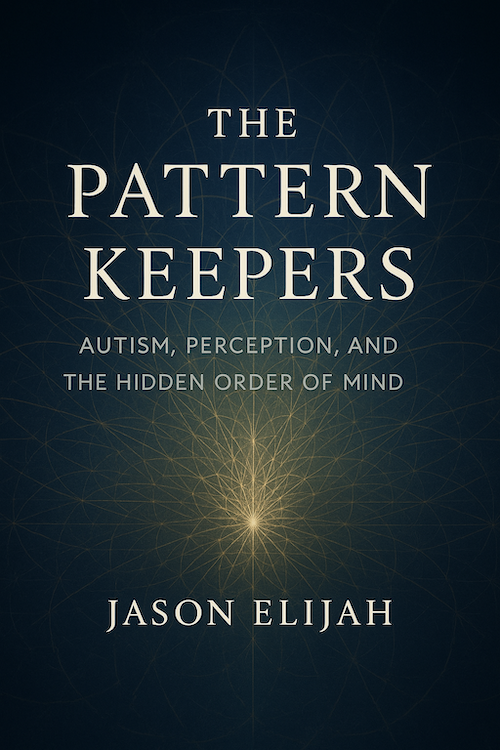
The Pattern Keepers
Autism, Perception, and the Hidden Order of Mind
Some minds perceive structure where others perceive noise.Available on Amazon ↗
About the book
The Pattern Keepers approaches autism not as a defect in human design, but as a distinct way of perceiving the world. It looks closely at minds shaped by pattern, precision, sensory intensity, and structural awareness, and asks what becomes visible when autism is understood on its own terms rather than constantly measured against neurotypical expectations.
Instead of framing autistic experience in terms of absence — absence of flexibility, ease, fluency, or social instinct — the book stays with what is present. It explores heightened pattern recognition, sensory depth, devotion to structure, literal language, intense focus, moral precision, and the search for coherence in a world that often feels noisy, contradictory, and overwhelming. What emerges is not a portrait of disorder, but of a mind trying to stay true to signals other people have learned to ignore or smooth over.
The book moves through the inner life of autistic experience with seriousness and care. It considers attention, language, empathy, boundaries, burnout, masking, emotion, silence, and ritual not as isolated traits, but as parts of a larger way of perceiving and organizing experience. Again and again, it returns to a simple point: what is often called impairment may sometimes be misunderstanding — a failure of the surrounding culture to recognize a different kind of mind.
The Pattern Keepers also resists romantic simplification. It does not turn autism into magic, purity, or abstraction. It stays close to the real cost of living in environments built for different nervous systems: the exhaustion of constant translation, the strain of sensory overload, the pressure to perform normalcy, and the loneliness of being read incorrectly. At the same time, it recognizes forms of perception and fidelity that can be deeply valuable — ways of seeing, feeling, and knowing that reveal details others may miss.
At its heart, this is a book about intelligibility. It asks what changes when autistic minds are no longer treated as puzzles to be solved, but as meaningful expressions of human variation. It invites the reader to see autism as a different way of organizing perception, one that keeps attention alive to pattern, truth, order, and structure in a culture that often rewards speed, performance, and noise.
Read an excerpt from this book
Prologue
The Silent Architect
Autism is not a single condition but a field of perception — a spectrum of attunement through which the human mind encounters the world differently. The brain that we call autistic is often described by science as more locally connected and less globally integrated, a network where information moves intensely within regions but less easily between them. This produces what researchers call detail-focused processing: an acute sensitivity to structure, pattern, and texture. What looks from the outside like withdrawal is often an overflow of awareness. The world arrives raw and unfiltered — light without curtain, emotion without buffer, meaning without translation. Yet beneath that flood lies coherence, an exquisite logic that most minds are too distracted to perceive.
To name this only as disorder is to mistake specialization for failure. What medicine calls hyperconnectivity might also be a kind of devotion — a consciousness oriented toward the hidden architecture of things. While most of us perceive melody, the autistic mind often hears the intervals, the silent ratios between notes. In mythic language, this is the gift of the Pattern Keeper — the archetype that preserves the syntax of creation. Where others move through narrative and noise, the Keeper listens to pattern. They remember what civilization forgets: that meaning begins in relationships, not in words. The rhythm between shape and sound, motion and stillness, signal and response. Their silence is not absence. It is reverence.
Daily life, however, can make this sanctity feel like exile. A world built for neurotypical speed and generalization demands constant translation. The classroom rewards fluency over precision; the workplace celebrates adaptability over depth. Conversations skim the surface of emotion rather than its underlying pattern. In such a world, the Pattern Keeper learns to build small temples of order — repetition, ritual, collection, arrangement. These are not symptoms of rigidity but prayers for coherence in an environment that refuses to slow down. What looks like fixation may be focus; what seems detached may be devotion.
When autistic people describe burnout, they are often describing the cost of translation — the exhaustion of performing a dialect not their own. Yet when allowed to inhabit their natural rhythm, their cognition reveals extraordinary beauty: minds that think in pictures, in motion, in geometry; memories organized by sequence, not structure; empathy expressed not in mimicry but in deep, pattern-based attunement. These are not anomalies. They are alternative languages of being.
Perhaps instead of asking how to make autistic people more like the world, it is time to ask how to make the world more capable of listening like them. The autistic mind is not a glitch in evolution; it is a refinement of perception, an echo of the first intelligence that mapped the stars and sensed the invisible order behind chaos. It reminds us that truth is not found in consensus but in coherence — not in conformity, but in clarity. The neurotypical mind generalizes to survive; the autistic mind particularizes to understand. Each serves the whole. Together, they complete it.
There is a rhythm beneath thought — a pulse of symmetry, a whisper of design. Some minds are born closer to that rhythm. They see it in the folding of leaves, in the flow of water, in the hum of electricity. They are not broken; they are the keepers of continuity. They remind us that silence is a language and that detail is a form of devotion. If the universe is written in code, they are the ones who still remember how to read it.