Threshold Seven · Belief
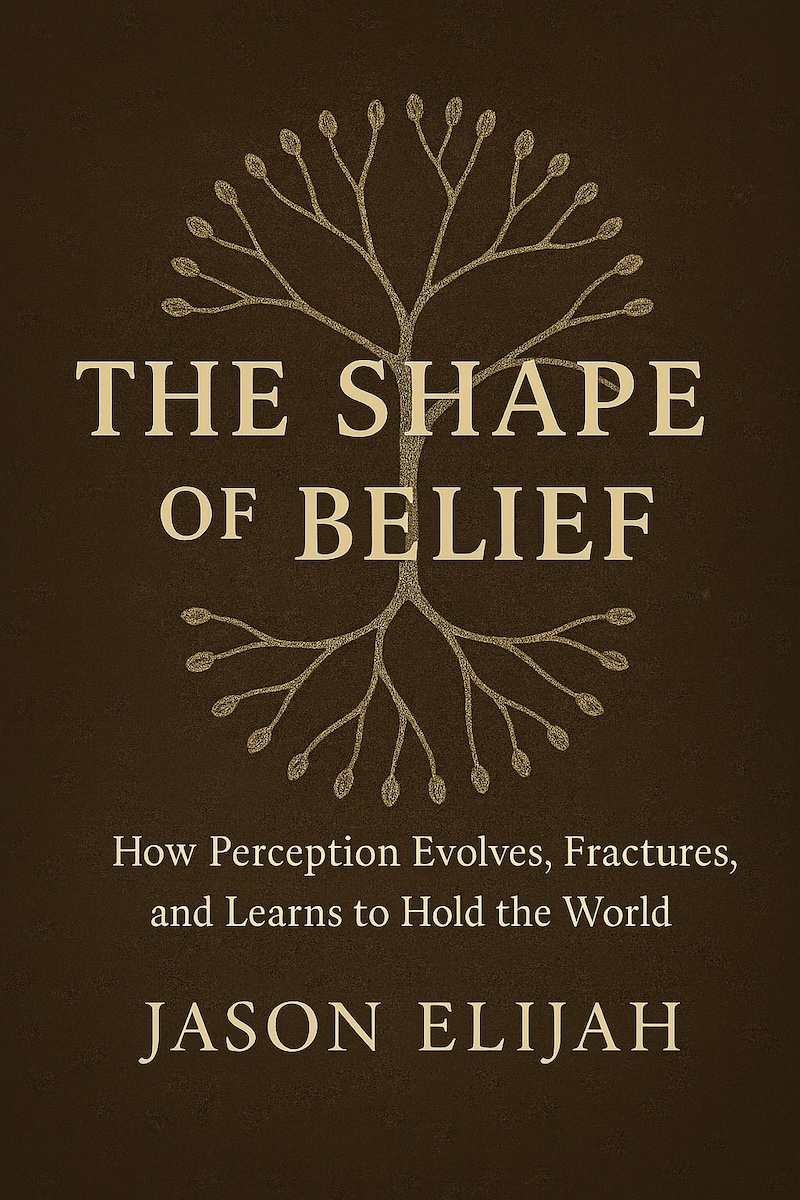
THE SHAPE OF BELIEF
How Perception Evolves, Fractures, and Learns to Hold the World
Belief is not an opinion, but a perceptual structure.Available on Amazon ↗
About the book
The Shape of Belief begins with a simple but disorienting recognition: belief is not just something people have. It is something they see through. Two people can use the same words and inhabit entirely different worlds. Two cultures can hold the same story and mean something radically different by it. The difference is not only in the belief itself, but in the way it is being seen.
This book explores belief at that deeper level. Rather than arguing for or against any doctrine, ideology, or worldview, it asks a quieter question: what kind of seeing makes a particular belief possible in the first place? From there, it traces the long evolution of human perception, showing how belief changed shape as ways of seeing changed with it.
The book moves through seven shifts in human perception. It begins in a world that feels alive, where meaning is encountered through participation rather than abstraction. It passes into mythic order, then into rational distance, inward psychological depth, plural ways of seeing, and finally the fragmentation that defines so much of modern life. What emerges is not a ladder of progress, but a layered map. Earlier modes never fully disappear. They accumulate and remain active inside later ones, sometimes in harmony, often in strain.
This is where the book becomes especially urgent. The Shape of Belief is not only about the past. It is about the pressure of the present. Modern people often live with several incompatible frames active at once — scientific explanation, moral narrative, psychological insight, cultural relativism, private meaning, collective history — without language for the strain this creates. What many people experience as confusion or personal failure is named here more carefully: overload.
Because of this, the book offers something more useful than argument. It offers orientation. Again and again, it shifts the reader away from the usual question, “What should I believe?” and toward another one: what kind of seeing am I using right now? That shift matters. It makes belief visible not as a fixed conclusion, but as a way of responding to changing conditions of life, meaning, complexity, and strain.
The book does not mock older frames or romanticize newer ones. Each threshold is treated as a real human achievement that revealed something necessary and concealed something else. Animistic participation gave belonging. Mythic order gave continuity. Rational distance gave precision. Psychological depth gave compassion. Plurality gave humility. Fragmentation revealed the cost of carrying too much without a shared map.
From there, the book turns toward its final movement: learning to hold without closing. This is not presented as a final worldview or a new belief system to defend. It is a capacity. A way of recognizing frames as frames, using them where they clarify, setting them down where they distort, and staying open without losing your footing. Belief does not need to harden in order to matter. It can remain alive, revisable, and responsible at the same time.
What emerges is a book about belief, but also about the strain of trying to carry reality in an age when no single frame holds on its own. It speaks to readers who feel divided between certainty and doubt, exhausted by argument, or quietly aware that the deeper crisis of the present is not only a crisis of truth, but a crisis of orientation.
The aim is not certainty.
It is clarity.
Read an excerpt from this book
Introduction
When Belief Stops Holding
There was a time when belief felt stable. Not because the world was simpler, but because the way people saw it was. A single frame could hold meaning, morality, and explanation at once. Life made sense inside that frame, even when it was harsh.
That time has passed.
What many people feel today is not confusion about facts, but strain in perception. Too many ways of seeing are active at once. Too many explanations compete for authority. Beliefs collide without instructions for how to coexist.
This is often described as a crisis of truth. It is more accurate to call it a crisis of holding.
Belief has never disappeared from human life. What changes across history is not whether people believe, but what belief is able to do. At different moments, belief has carried participation, order, explanation, interior meaning, plurality, and now fragmentation.
Each of these was once an achievement, emerging because a new way of seeing became possible.
Modern people inherit all of them at once.
We can feel the world as alive and still analyze it as an object. We can believe in moral stories while doubting their universality. We can understand psychological depth while being pulled apart by competing narratives. None of these ways of seeing are wrong on their own. The problem arises when they operate simultaneously without integration.
This is what fragmentation feels like.
Not madness.
Not failure.
Overload.
Many readers arrive here with a quiet fear that something is wrong with them. That they should be more certain, more decisive, more grounded than they feel. This book does not diagnose that feeling as a personal flaw. It names it as a structural condition of modern perception.
You are not broken.
You are carrying too much without a map.
This book is not a history of religion, though it will touch ancient ground. It is not a psychological manual, though it cares deeply about interior life.
It is a map of perceptual thresholds.
Thresholds are not stages you outgrow. They are conditions that make certain beliefs possible. Each one adds capacity. None of them erase what came before. When they accumulate without coordination, they pull against each other.
This book traces seven such thresholds. Not as a ladder of progress, but as layers of seeing. You may recognize yourself in more than one. You almost certainly live inside several at once.
The aim here is not to tell you what to believe.
It is to help you notice how you are seeing.
When that shift happens, a different question becomes available.
Not, “What should I believe?”
But, “What kind of seeing am I using right now?”
That question does not demand an answer. It creates orientation.
And orientation is what allows belief to be carried without breaking the one who holds it, or the world it touches.
This book does not promise certainty.
It offers coherence without closure.
That is enough to begin.
You do not need to remember everything that follows. You only need to notice where you recognize yourself.