
Threshold Eleven · Feeling
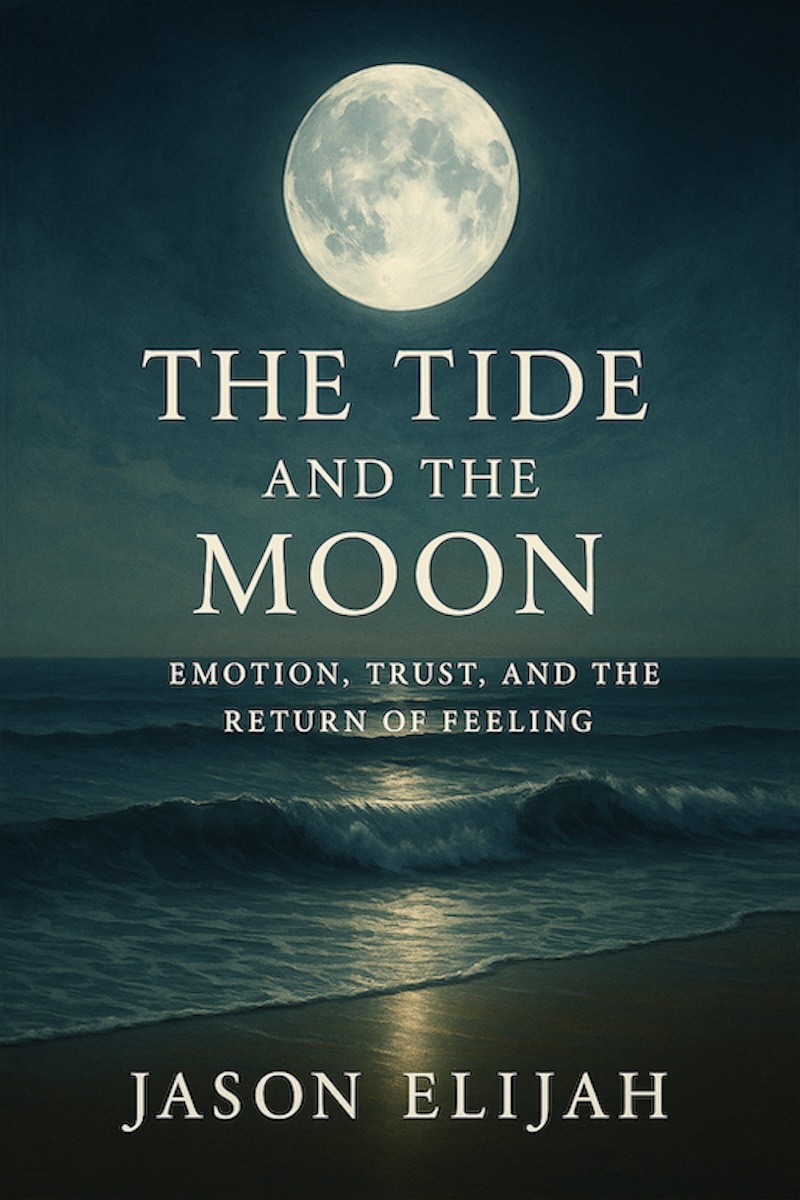
THE TIDE AND THE MOON
Emotion, Trust, and the Return of Feeling
Emotion is not opposed to reason; it is the medium through which trust, judgment, and relationship become possible.Available on Amazon ↗
About the book
The Tide and the Moon is a book about emotion as a form of intelligence. Not emotion as excess, weakness, or instability, but as living information that helps human beings know what matters, recognize what is safe, feel what is true, and remain in contact with one another. It begins from the recognition that many people have not lost feeling altogether. They have lost trust in feeling. They have been taught to brace against it, manage it, suppress it, or translate it too quickly into thought.
From there, the book turns toward the deeper rhythm underneath emotional life. Feeling is not treated as random weather inside the self, but as movement. A tide. Something meant to rise, crest, and return. When that movement is welcomed, emotion becomes orienting. When it is interrupted, denied, or feared, it begins to harden into pressure, numbness, confusion, exhaustion, or rupture. What looks like strength is often armoring. What looks like peace is often stillness imposed on water that never stopped trying to move.
This gives the book its central relationship: emotion and trust. Again and again, The Tide and the Moon shows that trust is what allows feeling to move without becoming chaos. Trust in the body. Trust in rhythm. Trust in safe relationship. Trust in the simple fact that a feeling can rise without needing to rule the whole self. The book treats trust not as abstract optimism, but as a physiological and relational condition, the pull that lets the tide come in.
Because of this, the book moves through the ways emotional life becomes interrupted. It explores the early armoring of the body, the small lessons by which children learn that tears are unwelcome, anger is dangerous, grief is inconvenient, and tenderness costs too much. It widens from there into the larger structures we build: workplaces, institutions, technologies, and social climates that reward composure while quietly starving coherence. The result is not only personal dryness, but a dry world — a society increasingly cut off from the very emotional intelligence it needs in order to remain humane.
But it does not stay in diagnosis. Its deeper movement is return. It follows the reappearance of emotional life through the lunar rhythm named in the title: the pull of trust, the currents of connection, the flood of awareness, the quieter work of integration, and the restoration of flow. Feeling begins to re-enter not as spectacle, but as a more honest way of living. Anger becomes boundary rather than destruction. Grief becomes proof that something mattered. Joy becomes nourishment rather than escape. Expression becomes the completion of meaning rather than the loss of control.
One of the book’s most beautiful recognitions is that emotion is never entirely private. Feeling happens between bodies as well as within them. Tone, gaze, breath, pace, and presence all shape what another nervous system is able to carry. This means that emotional life is not only personal work. It is relational and cultural work. Trust can be built in rooms. Coherence can be shared. A steadier presence can change the climate around another person. The tide returns not only to individuals, but to families, communities, and societies willing to stop treating feeling as a threat.
The book offers a vision of emotional life that is both tender and exact. It does not ask the reader to indulge every feeling or turn emotion into authority. It asks for something wiser: to let feeling become legible again, to let the body speak in its own language, and to distinguish message from impulse, movement from collapse, and truth from mere intensity. In that sense, the return of feeling is not a descent into chaos. It is a return to contact.
At its deepest level, The Tide and the Moon is a book about restoration. It is about what happens when people stop confusing numbness with maturity, stillness with peace, and control with wisdom. About what becomes possible when emotion is allowed to move cleanly enough to inform thought, deepen relationship, and restore proportion to human life.
The tide inside us was never the problem.
The problem was forgetting how to trust its movement.