Threshold Fourteen · Participation
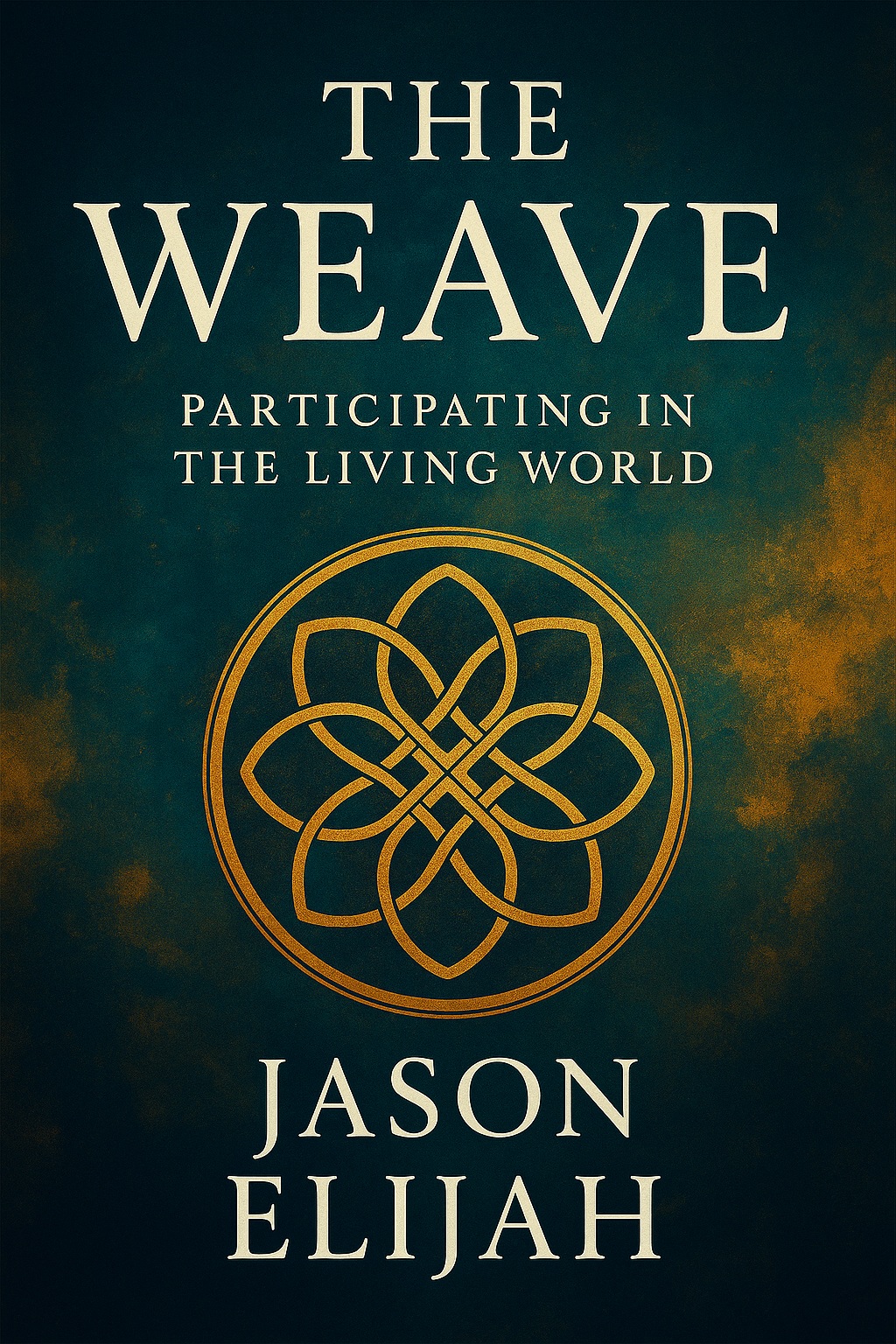
THE WEAVE
Participating in the Living World
Participation is already occurring; the question is whether it is conscious.Available on Amazon ↗
About the book
The Weave is a book about participation. It begins from a simple but unsettling recognition: human beings are never standing outside the world they affect. Attention changes what it touches. Intention leaves pattern. Words enter other nervous systems. Presence alters rooms. Even silence carries texture. Long before we understand what we are doing, we are already shaping the world around us.
Rather than treating life as a machine made of separate parts, the book turns toward an older image: thread, cloth, pattern, relation. It explores how attention functions like thread, how intention gives pattern to that thread, and how belonging reveals that no strand exists alone. The result is not mysticism detached from life, but a grounded understanding of participation itself. The world is not inert. It is relational, responsive, and continuously shaped by the quality of contact moving through it.
Because of this, The Weave moves freely across languages that are often kept apart. Neuroscience, ecology, psychology, myth, ritual, prayer, embodiment, and social life appear here not as competing explanations, but as different ways of approaching the same reality: interdependence. The book is interested in what becomes visible when those ways of seeing are allowed to speak to one another instead of competing for ownership of truth.
The movement of the book deepens gradually. It begins close to the body and its capacities for attention, coherence, blessing, and belonging. From there it widens into relationship, ritual, technology, collective imagination, and the futures human beings are already helping shape together. Along the way, it asks what prayer becomes when understood as participation rather than petition, what blessing becomes when treated as a form of deliberate attention, and what responsibility becomes once people can no longer pretend their inner life remains private after it enters shared systems.
Yet the book does not romanticize participation. Fear can be woven. Manipulation can be woven. Technology can become a loom for fragmentation as easily as for solidarity. Repetition can strengthen life, and it can also strengthen confusion. Again and again, the book returns to the recognition that human beings are always transmitting something into the worlds around them, whether consciously or not. Because of this, The Weave turns not only toward belonging, but toward guardianship: the need to recognize destructive patterns, protect attention, and choose more carefully what kinds of realities our lives are helping construct.
The reader is asked to feel the thread in their own hands. To realize that every act of attention is already participation. Every gesture of care is already shaping a pattern. Every story repeated about the future is already part of the future’s construction. The question is never whether we are weaving.
The question is whether we are weaving unconsciously or awake.
By the end, The Weave becomes an invitation into a more deliberate way of being human. Not grandiosity. Not performance. A steadier form of participation. More conscious. More reverent. More responsible. It offers a vision of life in which blessing becomes practical, coherence becomes protective, ritual becomes repair, and the world no longer feels separate from the way we move through it.
We are not standing outside the tapestry.
We are threads within it, and our presence matters.