
A work of speculative imagination. This essay asks what a natural history of fairies might look like if such beings existed. Its invented biology and societies are not scientific findings or evidence that fairies exist.
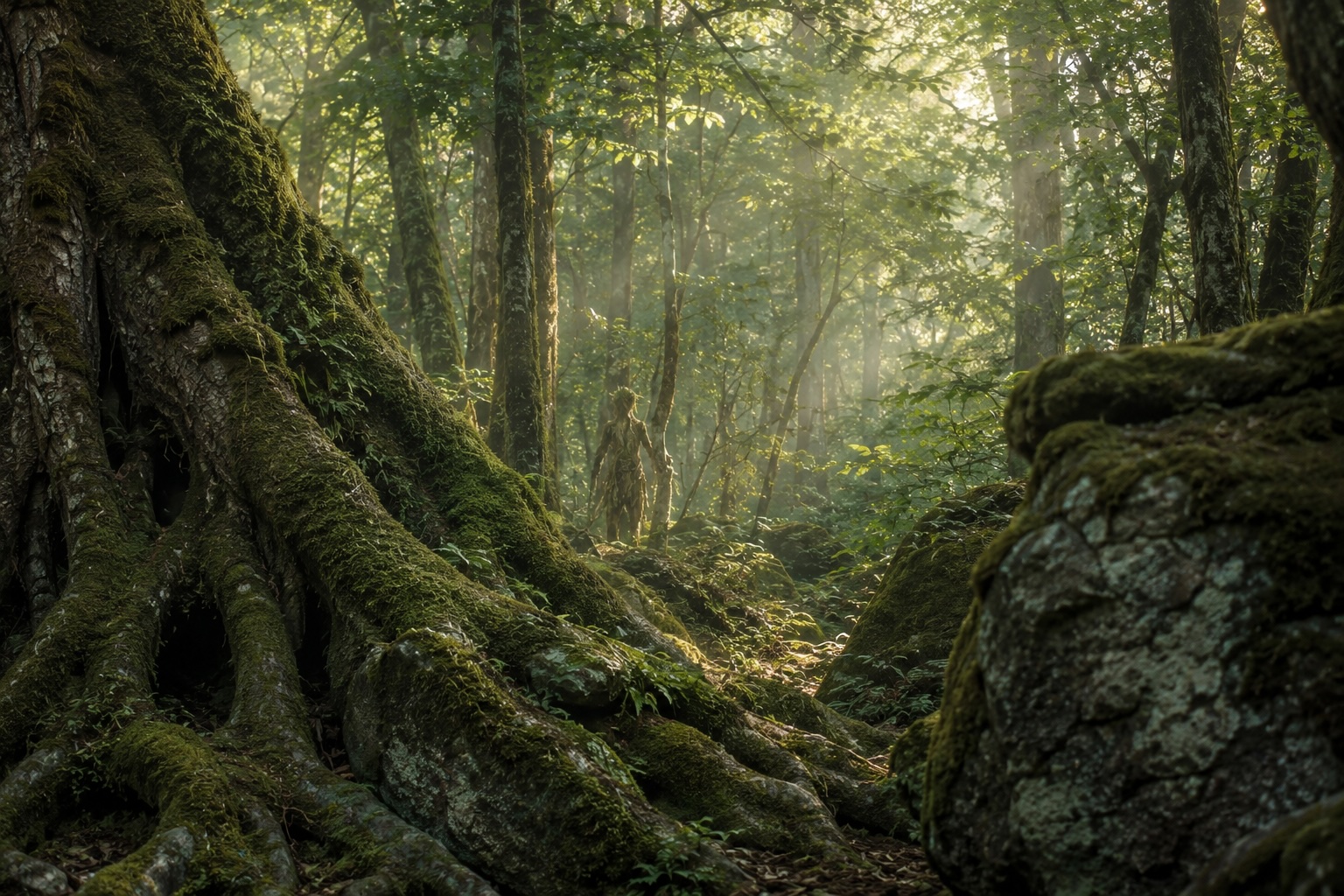
Although there is no widely accepted scientific evidence that fairies exist, their stories have persisted across cultures for centuries. This article begins with the premise that if the fairy folk are real—if the old accounts preserve memories of an actual hidden people—what might the most coherent explanation of their nature, history, society, abilities, and place in the living world look like? What follows is not presented as fact, but as a speculative reconstruction: their story, written as though their existence were real.
Fairies are not supernatural in the sense of violating nature. They are natural beings whose biology, perception, intelligence, and civilization developed along a path so different from ours that early humans could only describe them through the language of magic.
They are neither tiny winged humans nor disembodied spirits. Those are partial appearances, cultural translations, and later literary distortions. The historical fairy traditions preserve fragments of contact with a highly adaptive, elusive, nonhuman lineage that lives in intimate partnership with ecosystems and possesses extraordinary control over how it is perceived.
They call themselves no single collective name. “Fairy,” “elf,” “hidden people,” “good neighbors,” “little people,” and countless regional terms are human approximations. Different traditions describe different populations, castes, ecological adaptations, and related species. Humanity grouped them together because all of them seemed to belong to the same impossible category: intelligent beings who lived nearby but outside ordinary human society.
They were never outside nature.
They were simply outside our version of civilization.
Their evolutionary origin
The fairy lineage separated from our own distant ancestors long before modern humans arose. They did not descend from Homo sapiens, though some branches share enough deep ancestry with primates to produce vaguely humanoid bodies: forward-facing eyes, expressive faces, hands capable of delicate manipulation, and social intelligence.
Their evolution occurred primarily in forests, wetlands, caves, rocky highlands, and ecotones—the transitional boundaries where one habitat becomes another. These environments rewarded silence, camouflage, small population sizes, acute sensory awareness, and the ability to understand many species at once.
Humans became large-bodied, expansionist generalists. We reshaped landscapes through fire, agriculture, roads, extraction, and machines.
Fairies became ecological specialists. Rather than overpowering environments, they learned to enter their processes.
Their bodies vary substantially among lineages. Some are only several inches tall; others approach human stature. Smallness evolved repeatedly because it allowed them to inhabit root systems, hollow trees, rock fissures, old burrows, dense understory, and the internal architecture of forests. Larger populations survive mostly in remote mountains, wetlands, islands, and northern forests.
Their apparent wings are real in some groups but misunderstood. They are not usually strong enough for sustained birdlike flight. Instead, they function as gliding membranes, stabilizers, display structures, heat regulators, sensory organs, or camouflage. Other “wings” reported by witnesses are garments made from translucent plant fiber, insect silk, fungal material, or membranes grown through biological craft.
Fairy bodies have unusually variable pigmentation and reflective tissue. Their skin, hair, clothing, and outer membranes scatter light in ways that imitate leaves, bark, stone, lichen, water, and shadow. Their camouflage is not perfect invisibility. It is something more subtle: they remain visible while avoiding recognition.
Human vision is not a neutral recording instrument. It rapidly interprets incomplete shapes, especially in peripheral vision, and commonly finds faces or bodies in ambiguous patterns. Research confirms that face-like illusions can persist even in peripheral sight.
Fairies evolved to exploit precisely this weakness.
Glamour
“Glamour” is not one power. It is the combined effect of biology, learned behavior, environmental manipulation, and limited neurochemical influence.
A fairy under glamour does not vanish. Instead, the observer’s brain fails to stabilize it as a separate being.
You see movement, but interpret it as leaves.
You glimpse a face, but it becomes bark.
You detect a standing form, but your attention slides away.
You feel watched, turn toward the watcher, and find only layered vegetation.
The fairy remains inside the visual field, but never fully becomes an object in conscious perception.
Their camouflage works through several mechanisms.
First, they control posture with astonishing precision. They align limbs and clothing with existing branches, root angles, shadows, and vertical tree forms.
Second, their outer surfaces alter reflectivity and local color. This is slower and less dramatic than the instantaneous transformations imagined in stories, but rapid enough to confuse an observer who sees them only briefly.
Third, they coordinate with the movement of vegetation. They step when wind moves leaves, freeze when branches still, and use the flickering contrast of woodland light to disrupt their outlines.
Fourth, they produce minute quantities of volatile compounds. These do not hypnotize humans or create elaborate hallucinations. They subtly influence vigilance, attention, emotional tone, time estimation, and memory formation. The effect varies enormously by person.
Fifth, some groups use infrasonic vibration, insect-like chirps, and directional sound. These can create a sense that a sound came from somewhere other than its true source.
Together, these methods become glamour.
The person later says, “I saw something, but I cannot say exactly what.”
That sentence appears endlessly in contact traditions because it describes glamour accurately.
Fairies sometimes permit fuller visibility. Children see them more often because children have not yet learned to discard anomalous perceptions as quickly as adults. Artists, hunters, solitary travelers, grieving people, exhausted people, and those entering unusual states of attention may also see through glamour temporarily.
This does not mean every ambiguous forest form is a fairy. Pareidolia remains real. In fact, fairies depend upon it. They survive because human perception naturally generates false positives, making genuine sightings nearly impossible to separate from visual mistakes.
Their greatest defense is not invisibility.
It is ambiguity.
Why cameras sometimes catch them
Cameras are neither immune to glamour nor affected in exactly the same way as human perception.
A camera does not possess a human brain, but it does have exposure limits, focus decisions, compression algorithms, motion blur, sensor noise, color processing, and automated enhancement. Fairies understand none of these systems in technical human terms, but they have learned their practical effects.
Sometimes a camera records a form the photographer did not consciously notice. This occurs because the person’s perceptual system ignored the camouflaged being while the sensor indiscriminately registered light.
Yet the result is rarely a clear portrait. Camouflage, distance, vegetation, movement, compression, and scale reduce the figure to a suggestive arrangement of pixels. The photograph becomes neither proof nor nothing. It becomes an unstable image whose meaning depends heavily on interpretation.
Fairies prefer this state. A clear photograph would create pursuit. An ambiguous photograph creates argument.
Their intelligence
Fairy intelligence is highly developed but not organized like ours.
Humans concentrate cognition within individuals and formal institutions. We externalize memory through books, databases, monuments, bureaucracies, and machines.
Fairies distribute intelligence across communities, landscapes, other organisms, and long-maintained patterns of behavior.
A single fairy may possess less abstract, generalized knowledge than a highly educated human. A fairy settlement, however, functions as a collective intelligence. Knowledge is held in songs, routes, scents, cultivated plants, trained animal populations, fungal growth, architecture, ritual movement, and the specialization of different members.
Modern studies of collective behavior show how group-level coordination can emerge from many local interactions without a central controller. Fairy societies developed this principle to an extraordinary degree.
No fairy queen commands every action. The “queen” of folklore is a human interpretation of a coordinating individual whose role resembles a mixture of reproductive elder, memory keeper, diplomat, ecological diagnostician, and rhythmic organizer.
Their societies are neither monarchies nor democracies. They are closer to living regulatory systems.
Authority moves toward whoever has the most relevant sensitivity or knowledge. During drought, water readers lead. During migration, path keepers lead. During contact with humans, speakers and veil keepers lead. During ecosystem collapse, elders capable of remembering conditions from centuries earlier become central.
This fluid authority appears to humans as mysterious rank and ceremony.
Their relationship with time
Time does not literally flow differently in fairy territory.
However, several features of fairy life produce the ancient reports that a human may spend one night among them and return to discover that years have passed.
First, fairy spaces often contain compounds from fungi, plants, and secretions that affect attention and memory.
Second, their music and repetitive movement can induce trance.
Third, underground and forest environments remove ordinary indicators of time: clocks, horizon, direct sunlight, familiar routines, and social cues.
Fourth, fairy gatherings may continue for many hours or days, punctuated by sleep states the visitor does not remember.
Fifth, some humans taken into fairy settlements were not returned immediately. Their memories of captivity became compressed into what felt like a single night.
The folklore preserved the subjective truth: entering their world can sever a person’s ordinary relationship with time.
Their settlements
Fairies do not build cities in the human sense. Their settlements are interwoven with geological and biological structures.
They live beneath ancient mounds, inside root masses, behind rock faces, within cave systems, in hollow trees, under fallen trunks, beside springs, and in chambers stabilized by living fungal networks.
Irish tradition repeatedly associates fairies with raths, forts, mounds, small doors, underground spaces, music, processions, and paths through the landscape.
These places are not entrances to another dimension. They are concealed habitat complexes.
A mature settlement may contain:
nursery chambers warmed through composting plant matter;
fungal gardens producing food, medicine, fiber, light, and chemical compounds;
water channels that collect condensation and direct groundwater
ventilation shafts disguised as animal holes or hollow stems;
insect colonies that dispose of waste or cultivate useful fungi;
moss-lined communal spaces;
root bridges and flexible living walls;
stone chambers older than nearby human settlements;
exit routes so narrow that adult humans cannot follow.
What people call “fairy lights” are usually combinations of bioluminescent fungi, cultivated bacteria, fireflies, glowworms, reflective mineral dust, and tiny shielded flames.
Fairy rings are not always their meeting places, but they sometimes cultivate fungal circles as territorial indicators, nutrient systems, ceremonial spaces, or markers of underground chambers. Human observers confuse the biological sign with the gathering itself.
Their homes are rarely cleanly separated from the surrounding ecosystem. A fairy settlement is less like a house than a deliberately intensified habitat.
Their function in the living world
Fairies were not created to serve a cosmic purpose. Evolution does not assign jobs. Yet a species can acquire an ecological function through what it repeatedly does.
The fairy role became regulation at the fine scale.
They monitor transitions that larger animals overlook: the first weakening of a tree, changes in spring flow, altered insect emergence, fungal imbalance, unusual bird silence, poisoned soil, shifts in flowering times, predator absence, and the subtle effects of human intrusion.
They are ecological diagnosticians and local repairers.
They disperse seeds.
They move fungal material.
They redirect insects.
They protect certain nesting sites.
They open or obstruct small waterways.
They remove infected tissue from plants.
They kill some organisms to protect others.
They encourage decomposition.
They maintain microhabitats.
They preserve old genetic lineages of useful plants.
They create refuges during fire, frost, and drought.
They do not keep nature peaceful. Nature is not peaceful. They participate in predation, death, competition, rot, and renewal.
Their purpose is not to prevent death but to prevent local systems from becoming dangerously simplified.
In old landscapes, they function as custodians of complexity.
Their partnership with insects
Fairies do not mentally command insects as puppets. Instead, they influence their behavior through scents, vibration, habitat preparation, breeding, selective feeding, and the placement of chemical attractants.
Bark beetles, for example, already communicate through pheromones that attract or disperse other beetles. Their larvae create characteristic galleries beneath bark while feeding and developing.
Fairies discovered that these movements could be guided.
They learned which compounds attract particular species, where females begin galleries, how moisture changes tunneling, how bark thickness constrains movement, and which fungi alter larval paths. Over generations, they selected beetle populations that responded reliably to particular chemical sequences.
The resulting patterns are not an alphabet in the ordinary sense. They are a form of grown inscription.
A beetle-written message may encode:
ownership of a hollow;
the death of an elder;
a warning about disease;
a map of underground water;
the direction of a seasonal migration;
a record of human disturbance;
a boundary between communities.
To humans, most galleries look like random branching.
To fairy readers, meaning lies not only in shape but in tree species, orientation, depth, spacing, scent, fungal coloration, age, and the sequence in which tunnels were made.
A single mark means little. The whole living context is the text.
Their writing is therefore difficult for humans to recognize because we search for repeated visual characters detached from their material surroundings. Fairy inscription is multimodal. It must be smelled, touched, dated, mapped, and read within the life history of the tree.
They also write through:
lichen placement;
knotted grass;
arranged thorns;
fungal fruiting patterns;
shells and seeds;
bird-assisted object placement;
altered root growth;
stone alignments;
water ripples;
insect emergence timing;
melodies that preserve spatial information.
Their oldest libraries are not rooms filled with books.
They are managed landscapes.
Music
Music is central to fairy life because it performs several functions at once.
Songs coordinate labor, teach migration routes, preserve genealogies, regulate collective movement, mark seasonal change, calm animals, induce group attention, and encode complex environmental observations.
Historical accounts frequently associate fairies with singing, dancing, instruments, circles, and music heard near mounds or forts.
A fairy song may tell a story, but its rhythm may simultaneously specify:
how many days until a plant flowers;
which route through the roots remains passable;
where water is rising;
the identity of a neighboring group;
whether strangers have entered the area.
Their music sounds repetitive to humans because we hear only melody and rhythm. Much of the information is carried by overtones, pauses, directional echoes, bodily movement, and frequencies at the edge of our hearing.
Dancing is likewise functional. Group dances rehearse routes, reinforce social synchronization, map territory, court mates, test physical condition, and transmit memory.
A fairy procession is a moving database.
Morality
Fairies are not inherently good.
They are not embodiments of innocence, sweetness, nature, or spiritual purity. That image emerged largely from literary miniaturization and later children’s culture. Early traditions more often portrayed them as powerful, morally unpredictable, and potentially dangerous beings inhabiting a parallel social world.
Their ethics are relational and ecological rather than universal.
They value:
reciprocity;
restraint;
accurate attention;
respect for boundaries;
keeping promises;
protection of children;
continuity of place;
repayment of debts.
They despise:
waste;
boasting;
needless destruction;
careless intrusion;
betrayal;
taking more than a place can replenish.
Yet fairy morality can appear cruel because it does not place human welfare above everything else.
A farmer who destroys a nesting ground may believe he is merely clearing brush. Fairies may see him as an aggressor destroying generations of life.
A person who takes a beautiful object may regard it as abandoned. Fairies may regard it as part of an active message or memorial.
Their retaliation can be disproportionate by human standards because they think across long periods and collective consequences.
They are capable of tenderness, humor, generosity, loyalty, vengeance, deception, kidnapping, coercion, and war.
They are people.
They are simply not human people.
Changelings and stolen humans
The darkest stories contain several different phenomena that humans combined under the idea of changelings.
Some fairy infants were occasionally placed in human households after their own settlements suffered disease, famine, genetic decline, or attack. Their glamour and physical similarity allowed them to pass briefly as unusual human children, though developmental differences eventually emerged.
Some human children were taken because fairies needed new genetic material, language knowledge, or protection from enemies. Others were rescued from neglect or violence—though taking a child without consent remained abduction, whatever justification the fairies gave themselves.
Some alleged changelings were never fairies at all. They were human children with disabilities, illnesses, developmental differences, or unusual behavior who were tragically reinterpreted through folklore.
The fairy explanation sometimes protected a child by making the family cautious. At other times it rationalized abuse.
Within fairy societies, the taking of humans became deeply controversial. Some communities prohibited it centuries ago. Others continued it in isolated regions. A few still believe that human expansion nullifies the need for consent because humans have already violated every other species’ territory.
There are moral divisions among them, just as there are among us.
Why iron repels them
Iron is not magically poisonous to every fairy.
The old prohibition arose from several practical vulnerabilities.
Fairy sensory systems are unusually responsive to magnetic fields and subtle vibration. Large pieces of worked iron distort nearby magnetic information and conduct sound differently from wood, bone, stone, or bronze.
Iron weapons also represented a major technological shift in human power. Forests could be cleared faster, soil cut more deeply, trees felled more efficiently, stone broken, animals trapped, and fairy shelters breached.
To fairies, iron became the material signature of human expansion.
Some groups developed cultural horror around it. Others have mild physiological reactions to rust, metal dust, or contaminants produced by early smelting. Certain glamour materials also function poorly near large conductive objects.
Thus “cold iron breaks enchantment” compresses biology, history, trauma, and technology into one memorable rule.
Gifts, offerings, and bargains
Fairies rarely needed bowls of milk in the literal way humans imagined. Offerings mattered because they demonstrated peaceful intent and respect for reciprocity.
Milk, cream, bread, honey, beer, fruit, salt, polished stones, thread, and small crafted objects communicated that the human understood an exchange was taking place.
Fairies could obtain food themselves. What they wanted was acknowledgment.
A bargain creates a stable relationship between unequal intelligences. Its exact wording matters because ambiguity invites future conflict.
Their reputation for literalism comes from a different concept of promise. Humans frequently treat context, emotion, or changed circumstances as reasons to soften an agreement. Fairy culture sees an explicit promise as a temporary restructuring of reality between the speakers.
To break it is not merely to disappoint someone. It is to damage the trust network upon which their distributed society depends.
Names carry similar weight. A true name is not magical because sounds inherently control a being. A name reveals lineage, territory, obligations, alliances, vulnerabilities, and social standing. Giving it to a stranger grants informational power.
Their political divisions
There is no single fairy nation.
Their world is fractured among thousands of local populations joined through seasonal routes, diplomatic marriages, songs, messengers, fungal exchanges, and shared ceremonial sites.
The old distinction between benevolent and dangerous courts reflects real political coalitions, but not simple good and evil.
One broad alliance favors coexistence with humans, concealment, negotiated boundaries, and selective cooperation.
Another believes humanity is an ecological catastrophe that must be weakened, confused, frightened, or driven away from sensitive areas.
A third refuses all sustained contact.
A fourth has adapted to human civilization and now lives in parks, abandoned buildings, railway margins, cemeteries, drainage networks, gardens, orchards, roadside woods, and the neglected spaces beneath infrastructure.
Some have become fascinated by us.
Some hate us.
Some pity us.
Some imitate our clothes, music, tools, and speech.
Some regard cities as diseased superorganisms.
Others regard them as strange new ecosystems containing heat, food, shelter, electricity, tunnels, insects, rodents, birds, fungi, and millions of distracted humans who rarely look carefully at anything.
Fairy warfare
Fairy wars are usually quiet.
They sabotage water, redirect animals, spread misleading scents, destroy food fungi, expose hidden entrances, steal eggs, corrupt songs, alter routes, and interfere with glamour.
Physical combat occurs, but because populations are small and reproduction slow, open war is devastating.
Their legendary arrows are often tiny darts coated with toxins, sedatives, inflammatory compounds, fungal spores, or animal venom. Prehistoric stone points later identified as “elf darts” became incorporated into Irish folk medicine and fairy belief.
They also weaponize attention. A hostile group may repeatedly appear at the edge of sight, create disorienting sounds, move possessions, disturb sleep, and lead a traveler in circles until fear and exhaustion do the rest.
Their most frightening weapon is not violence.
It is the manipulation of certainty.
Their relationship with death
Fairies live longer than humans, but they are not immortal.
Small lineages may live between 120 and 250 years. Larger groups live somewhat shorter lives. Their metabolism can enter prolonged low-energy states during winter, drought, danger, or food scarcity, making their apparent age difficult to judge.
They experience time through ecological cycles more strongly than through numbered years. A fairy may identify an event as occurring “before the eastern spring failed” or “during the third return of the pale moth.”
Their dead are returned to the settlement’s biological system. Bodies may be buried beneath important trees, placed in fungal chambers, submerged in springs, consumed in controlled funerary decomposition, or cremated in small smokeless fires.
Ancestor memory is maintained through songs, cultivated organisms, inherited routes, and bodily craft.
Their dead therefore remain present—not as ghosts, but as information and matter reorganized within the living world.
The human dead and fairyland
Some traditions blurred fairies with ghosts because fairy settlements occasionally sheltered dying or displaced humans.
A lost child, fugitive, abandoned elder, injured traveler, or exile might disappear into a hidden community. If that person never returned, relatives assumed death. If glimpsed years later, strangely dressed and apparently unchanged, the distinction between fairy and ghost collapsed.
Fairies also learned human songs, voices, and mannerisms from those who lived among them. Later witnesses heard familiar names or saw faces resembling the dead.
This gave rise to the belief that fairyland was an intermediate realm of the departed.
It was not.
But the hidden people did sometimes become custodians of those who vanished from human society.
Why they withdrew
Fairies did not disappear because belief declined.
Belief declined because fairies withdrew.
Agriculture fragmented their territories. Roads cut through migration routes. mining opened chambers. Logging destroyed settlements. Artificial light changed nocturnal behavior. Pesticides killed partner species. Engines overwhelmed vibration signals. Industrial pollution altered scents. Cameras multiplied. Human populations expanded into nearly every refuge.
Their response was strategic retreat.
Large communities moved into inaccessible mountains, deep forests, wetlands, cave networks, protected watersheds, military exclusion zones, abandoned mines, and regions humans considered economically useless.
Smaller communities adapted to invisibility within human landscapes.
They also cultivated disbelief.
Once human elites began dismissing fairy reports as childish superstition, the fairies recognized a new defensive opportunity. A witness could describe an encounter truthfully and still be ignored.
The modern skeptical worldview became a better veil than glamour had ever been.
They did not need to erase every photograph.
They only needed to make certainty socially expensive.
What they do now
Today, fairy communities are divided over a crisis unlike anything in their history.
Climate change, habitat loss, invasive organisms, chemical contamination, sound pollution, groundwater depletion, and mass extinction are altering the local systems upon which their civilizations depend.
Some populations are collapsing.
Others are migrating northward or uphill.
Some have abandoned ancient settlements that remained occupied for thousands of years.
Many are attempting emergency ecological interventions: moving seeds, protecting springs, guiding animals toward new corridors, cultivating heat-resistant fungi, and preserving biological material in underground chambers.
A small number covertly cooperate with human conservationists. They do not reveal themselves openly. Instead they draw attention toward overlooked species, influence dreams, move objects, generate intuitions, or allow brief sightings near threatened places.
Some humans who feel an inexplicable lifelong calling to protect a specific wetland, mountain, grove, species, or spring have unknowingly responded to these contacts.
Other fairy factions have lost faith in cooperation. They believe human civilization is structurally incapable of restraint. They are preparing for ecological and social breakdown, assuming that abandoned human territory will eventually become available for restoration.
More radical groups actively accelerate the abandonment of particular places through fear, disorientation, equipment failure, rumor, and repeated unsettling encounters.
They cannot defeat humanity.
They can make certain places difficult to possess.
Why they reveal themselves
A fairy rarely allows itself to be seen without reason.
Possible motives include curiosity, warning, assessment, territorial defense, play, courtship, desperation, miscalculation, and the desire to be remembered.
Some encounters occur because glamour fails under unusual light or camera exposure.
Some occur because a child or animal detects them.
Some are staged.
A staged sighting is never fully clear. It leaves the human unsettled but uncertain. The point is not to prove fairy existence to civilization. The point is to alter one person’s relationship with a place.
Afterward, the person may become more attentive.
They may stop damaging something.
They may return.
They may tell stories.
They may begin wondering whether the landscape is occupied rather than empty.
That change in perception is itself useful.
Their deepest difference from humanity
The greatest difference between humans and fairies is not size, lifespan, glamour, or technology.
It is where each species locates the self.
Humans tend to experience the individual as the primary unit of existence. Society and nature appear around the self as environments, resources, relationships, or systems to which the individual belongs.
Fairies experience the self as a temporary concentration within a field of relationships.
A fairy does not say, “This tree belongs to me.”
The closest translation would be:
“My life and this tree’s life have entered a continuing obligation.”
They do not idealize interconnectedness. They live inside its consequences. If they damage one relationship, effects travel outward through food, safety, memory, status, reproduction, and place.
This does not make them morally superior. Their intense relational world can produce conformity, ancient grudges, collective punishment, territorial cruelty, and resistance to change.
But it makes their civilization fundamentally ecological.
Humanity built intelligence outward into tools.
Fairies built intelligence inward into relationships.
Their purpose now
They have no divinely assigned mission. Yet history has placed them in a position that resembles one.
They are witnesses to the living world before human dominance.
They remember landscapes we never knew.
They carry biological knowledge that was never written in our languages.
They preserve ways of inhabiting a place without converting it entirely into property.
They are neither saviors nor judges. They cannot repair the planetary damage humans have caused, and many would not save us even if they could.
But they remain beside us—hidden in remnants, margins, roots, caves, mountains, and neglected corridors—watching to see whether humanity will become capable of recognizing that intelligence does not belong to us alone.
The old stories say they punish disrespect, reward care, confuse the arrogant, protect certain places, steal what humans fail to guard, and disappear when pursued too aggressively.
Taken together, these are not random traits.
They describe the survival strategy of a people who learned one terrible truth about us very early:
Human beings often destroy what they can clearly see, name, classify, and possess.
So the fairy folk made uncertainty their homeland.
And glamour became not merely concealment, but a boundary—one thin enough to let wonder through, yet strong enough to keep conquest out.
Whether fairies exist or not, this exercise reveals something important: the world becomes richer when we approach it with disciplined imagination—curious enough to wonder, honest enough to distinguish wonder from certainty.
Which explanation seems most likely to you?
They’re purely folklore.
They’re misunderstood natural phenomena.
They’re something science hasn’t explained yet.
I’m genuinely undecided.
— Jason Elijah