
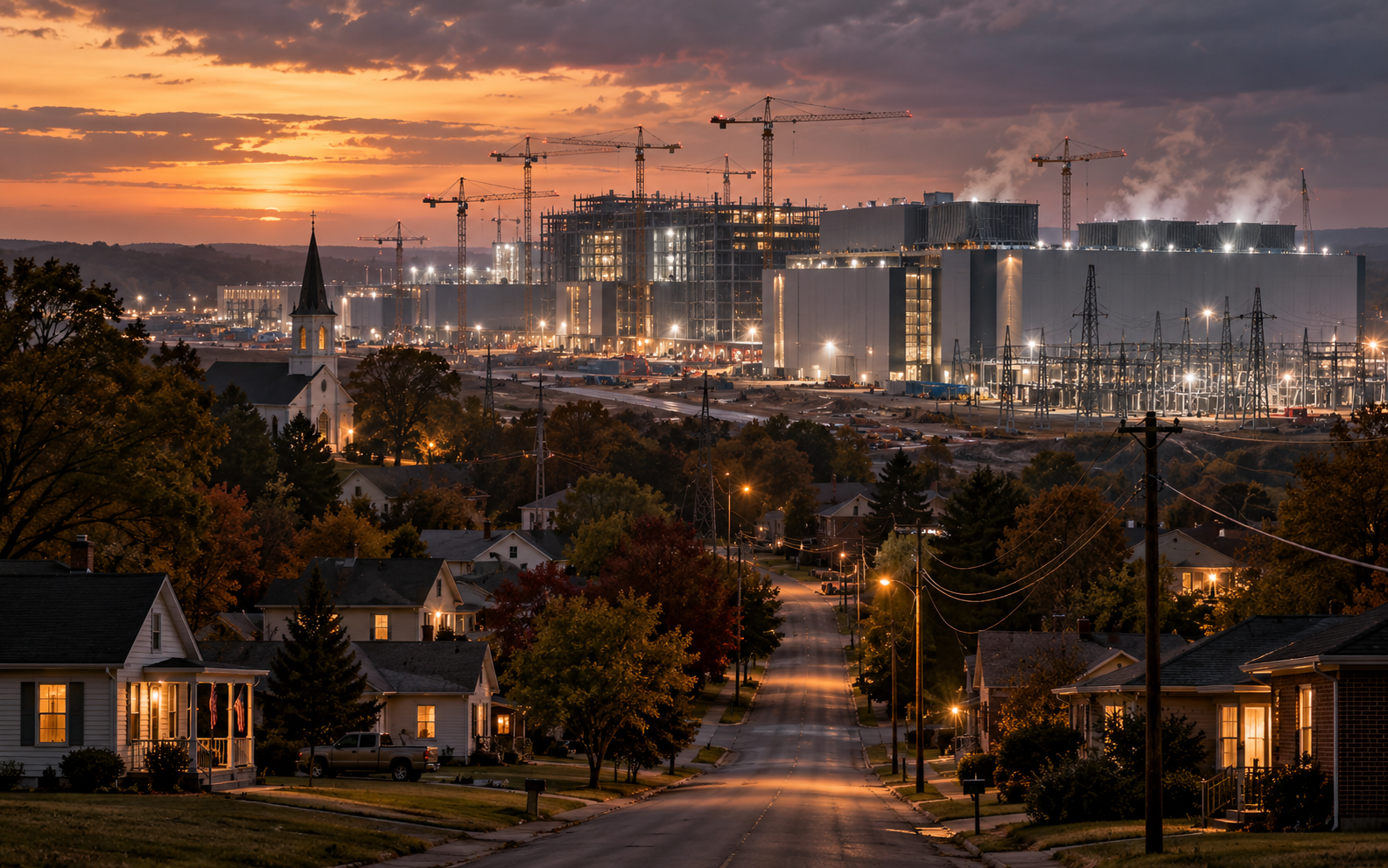
At a town hall in Boyce, Louisiana, residents wanted to see the environmental study for a massive data center being built near their community. Company representatives and local officials assured them that an independent assessment had found little cause for concern. When residents asked to see the findings, they were told the study would not be released.
The meeting, held in June 2026, grew heated. Pastor Robert McLane of Cotile Baptist Church reminded officials of something that seemed to have been overlooked during the negotiations. "We live here. Our children go to school here. We want to know how it impacts us."
The project, now known as Delta Forge 1, is a planned $3.6 billion development whose first phase is expected to draw 300 megawatts of electricity. Negotiations had taken place under nondisclosure agreements signed by several state and local officials. Some of those agreements identified the development only by code names: Project Lightning and Project Pixel. By the time residents learned much about the plans, the project had already received approval and construction was beginning.
Officials defended the secrecy as a necessary part of attracting major investment. They anticipated more than a thousand construction jobs and approximately 200 permanent positions. Those are meaningful opportunities in a small community, and residents had reason to be interested in them. They also had reason to want answers about what the project would require from their land, water, electrical infrastructure, and surrounding environment.
As reporting by the Gulf States Newsroom and Type Investigations Source ↗ revealed, the secrecy surrounding Boyce was part of a much wider practice. Companies seeking to build data centers have negotiated confidential agreements with public officials across the country, sometimes leaving residents with little opportunity to examine proposals before important decisions are made.
The Boyce controversy captures an uncomfortable feature of our technological future. Artificial intelligence is advancing at astonishing speed, promising discoveries and capabilities that could profoundly improve human life. Yet the infrastructure required to support those advances is being built in places where people already live, work, raise families, and depend on the surrounding environment. These communities are finding themselves drawn into an industry whose ambitions stretch far beyond their borders, often with little influence over the decisions affecting their daily lives.
We talk about artificial intelligence as though it exists somewhere beyond the ordinary physical world. We encounter it through screens, typing a question and receiving an answer almost instantly. It's easy to forget the enormous machinery behind that exchange: computer chips manufactured from materials extracted from the Earth, buildings filled with servers, cooling equipment, power plants, transmission lines, and the infrastructure needed to keep everything operating.
The cloud has a considerable footprint on the ground.
And that footprint is growing.
In an October 2026 interview with Jon Favreau Source ↗, environmental advocate Erin Brockovich described how she became involved in investigating the expansion of hyperscale AI data centers. Her interest began when residents of a Pennsylvania community contacted her about a proposed development. As she started examining their concerns, she wondered how many other communities were experiencing something similar. She created an online reporting system, and nearly 4,000 submissions arrived during its first month, according to the interview.
People wrote about water supplies, electricity bills, noise, pollution, declining property values, and changes to landscapes they had known for generations. Some described health problems they suspected might be connected to nearby facilities, concerns that require independent investigation before any causal conclusions can be drawn. The reports varied, but Brockovich was struck by how often residents described being kept in the dark about developments that could permanently change their surroundings.
That lack of transparency should concern anyone who believes communities deserve a meaningful role in shaping their own futures. A farmer may understand local water conditions that a developer has never encountered. Residents know which roads flood, where wildlife travels, and how industrial activity affects the rhythm of daily life. Such knowledge may be incomplete or sometimes mistaken, just as a developer's projections may be. It deserves consideration alongside technical studies rather than being dismissed because it comes from people without specialized credentials.
Of course, communities disagree about development. Some residents may welcome the jobs and tax revenue while others oppose the loss of agricultural land or worry about environmental consequences. Local governments have legitimate reasons to pursue investment, and developers sometimes need to protect commercially sensitive information while negotiating. None of this makes public participation simple. But confidentiality becomes a serious problem when it prevents people from learning information they need before decisions can still be changed. Residents cannot participate meaningfully in a process whose essential details remain unavailable until the outcome is nearly settled.
The stakes are increasing with the industry's demand for electricity. A report published in June 2026 by Lawrence Berkeley National Laboratory Source ↗ estimates that data centers could account for approximately 11.8 percent of all electricity consumed in the United States by 2030, with scenarios ranging from 9.5 to 15.3 percent. Those figures cover data centers generally, although the rapid growth of AI computing is a major factor. They are projections subject to considerable uncertainty, particularly as computing efficiency and demand continue to change. Still, they suggest a remarkable expansion of infrastructure that must be planned, financed, and supplied with energy.
Electricity is only part of the picture. Cooling systems vary enormously in their water requirements, and the surrounding climate can make a substantial difference. A facility using relatively little water onsite may still depend on electricity generated elsewhere through water-intensive processes. Other systems can reduce both energy and water demands under suitable conditions. Research has shown Source ↗ that the environmental consequences depend on the interaction of cooling technology, local conditions, electrical generation, and computing efficiency. There is no universally superior design that can be installed everywhere with the same results.
This makes the location of a data center an environmental decision as well as a commercial one. A facility that can operate responsibly in one region may place unreasonable demands on resources in another. Construction may also require new transmission corridors, affect wildlife habitats, or replace farmland and forests. Those consequences need to be examined before companies commit themselves to projects that become increasingly difficult to alter.
Then there is the question of money.
A data center can require expensive upgrades to the electrical grid. Whether those costs increase bills for surrounding households depends on how utilities and regulators allocate them. The distinction matters because companies sometimes present these developments as tremendous economic opportunities without giving equal attention to the public expenses they may create. In 2026, Virginia regulators moved toward assigning more of the direct costs Source ↗ of serving data centers to the facilities responsible for them, including substations and other infrastructure built to meet their demand.
Such decisions demonstrate how much depends on public policy. Developers can be required to pay a fair share of the costs their operations create, and agreements can protect existing customers if a proposed facility consumes less electricity than anticipated or closes before infrastructure investments have been recovered. These arrangements require careful planning, but the principle is familiar enough: businesses should account for the foreseeable consequences of their operations.
The same principle applies to environmental protections. A responsible developer should be able to explain how much water a facility will require, where that water will come from, how noise and pollution will be controlled, and what will happen when the equipment eventually becomes obsolete. Independent monitoring can establish whether those commitments are being honored. Financial guarantees can help ensure that surrounding communities aren't left paying for environmental restoration or abandoned infrastructure years after a company has moved on.
For an industry investing billions of dollars in increasingly sophisticated technology, these obligations should be manageable parts of doing business. Yet they can become contentious when speed, competitive advantage, and the pursuit of favorable financial terms take precedence over careful planning.
That brings us to a larger question, one extending well beyond the construction of data centers.
What would the artificial intelligence industry look like if its success were judged primarily by its contribution to human well-being and the health of the living Earth?
The question challenges assumptions that have guided technological development for generations. Companies compete to introduce new products, attract investment, increase market share, and outperform their rivals. Those incentives can produce remarkable innovations, often more quickly than anyone expected. They can also encourage organizations to pursue growth without adequately examining what that growth means for the people affected.
In the AI industry, the pressure is particularly intense. Companies are competing to build increasingly capable systems, governments are concerned about maintaining technological leadership, and investors are committing enormous sums in anticipation of future returns. The possibility of creating genuinely transformative technology has become intertwined with the fear of falling behind.
Under those circumstances, slowing down to consider environmental costs, employment consequences, or the concerns of a small community can appear commercially disadvantageous. A competitor may be willing to move faster or negotiate a more favorable agreement elsewhere. The pressure to proceed can be enormous, even when legitimate questions remain unanswered.
A company whose primary obligation is to increase its financial value will naturally make decisions within that framework. It may sincerely want its products to improve people's lives, and many of its employees may care deeply about that purpose. But good intentions do little to resolve a conflict when acting responsibly threatens profitability or competitive advantage. The outcome depends on what the institution is required, encouraged, and permitted to do.
Imagine applying a broader measure of success to some of AI's most promising applications.
In education, we might examine whether students are developing stronger reasoning skills, gaining access to instruction they previously lacked, and becoming better equipped to learn independently. The number of people using an educational platform would tell us something about its popularity and reach, but we would also want evidence that it was helping people learn.
Healthcare offers equally important possibilities. AI could help physicians recognize diseases earlier, reduce administrative work, and bring specialized assistance to underserved communities. A hospital might use those capabilities to improve patient care and give medical professionals more time with the people they treat. Another might use automation chiefly to reduce staffing expenses, with uncertain consequences for patients and employees. The same underlying technology could contribute to very different outcomes depending on the decisions governing its use.
Consider the workplace, where AI may allow people to accomplish tasks in minutes that previously required hours. Employers could share some of those productivity gains through shorter working hours, improved compensation, or less exhausting conditions. They could also increase workloads, reduce staffing, or retain most of the economic benefits. Both possibilities are compatible with technological advancement. The difference lies in how organizations distribute the value their workers and tools produce.
We have encountered similar choices during earlier periods of industrial and technological change. Machines increased productivity, new industries emerged, and entire occupations were transformed. Living standards improved for many people, sometimes substantially, while others experienced unemployment, displacement, or the decline of communities built around industries that no longer existed. Public policies, labor protections, educational opportunities, and economic institutions influenced who benefited and who struggled.
Artificial intelligence will operate within the institutions we already have, including their inequalities, incentives, and limitations. Its capabilities may be new, but the questions about power and responsibility are familiar.
What is different now is the extraordinary range of activities AI may eventually influence. Education, medicine, scientific research, public administration, employment, communication, and personal decision-making are all potential areas of transformation. The consequences could reach into nearly every part of ordinary life, making it especially important to examine who controls these systems and how their effects are evaluated.
We should also be cautious about assuming that an organization becomes trustworthy merely because it declares a commitment to humanity. History offers plenty of examples of institutions established for admirable purposes that eventually became secretive, self-protective, or indifferent to the people they were meant to serve. Corporate ownership is not the only source of that danger. Governments, universities, charitable organizations, and public-interest institutions also require oversight and accountability.
A more humane AI industry would need rules and incentives that make responsible behavior practical, expected, and enforceable. Environmental assessments would carry consequences. Communities would have opportunities to influence development while alternatives remained possible. Workers and other affected groups would be represented in decisions about major changes to their lives. Independent researchers would be able to examine important claims about safety and effectiveness, subject to legitimate privacy and security protections. Companies would be expected to disclose material risks and correct problems rather than treating criticism primarily as a threat to their reputations.
These protections would have costs, and disagreements about their design would be inevitable. Excessively restrictive rules could discourage useful research or prevent beneficial technologies from reaching people who need them. Some innovations require substantial investment and involve risks that cannot be eliminated. The aim should be to make those risks understandable, proportionate, and subject to meaningful oversight, with particular care for people who have little power to protect themselves from the consequences.
There is also a question the industry rarely seems eager to discuss: whether every possible application of AI deserves to be developed and deployed.
An enormous amount of computing power may be justified by research that helps treat serious diseases or improves our understanding of the natural world. Other applications may offer comparatively modest benefits while consuming significant resources. Determining which activities are worthwhile involves scientific, economic, environmental, and ethical judgments, and reasonable people will disagree about the answers. But the ability to create something does not settle whether creating it is a good use of our collective resources.
Nor can those judgments be left entirely to the companies positioned to profit from them.
People who use AI have a place in this conversation, too. For many, the technology has opened possibilities that were previously inaccessible. A person working alone can research unfamiliar subjects, develop ideas, create sophisticated projects, or learn skills that once required expensive assistance. These are meaningful gains in individual capability, particularly for people who lack institutional support or financial resources.
At the same time, our activities contribute to the demand for computing infrastructure. We depend on systems whose environmental and economic consequences are often difficult for ordinary users to evaluate. There is a responsibility to remain informed and ask questions, although it would be unreasonable to place the burden of reform primarily on individual consumers. The people making billion-dollar investment decisions possess far more information and control than those using the resulting services.
What interests me most is the possibility that AI itself could help change this imbalance.
One of the difficulties ordinary communities face when confronting a large corporation is the difference in access to specialized knowledge. A developer may arrive with engineers, attorneys, financial consultants, and experts in zoning and environmental regulation. Residents may have jobs, families, and limited time to examine hundreds of pages of technical documents. Even obtaining those documents can be a struggle.
AI could help people navigate that complexity. Residents might use it to understand environmental assessments, compare utility agreements, identify questions worth asking, or examine the reasoning behind official claims. It could assist community groups in researching alternatives and communicating with specialists. Such systems would need to be used carefully, since AI can misinterpret documents and produce convincing but incorrect explanations. Independent verification would remain essential. Nevertheless, making technical knowledge more accessible could help ordinary people participate in decisions that have traditionally favored those with the money to hire experts.
There is something especially promising about a technology becoming useful in this way. People who once felt overwhelmed by complicated institutions could gain greater confidence in their ability to understand and question them. They might become better equipped to distinguish genuine risks from exaggerated fears, recognize when a developer has made reasonable accommodations, and identify concerns that still require attention.
Brockovich's investigation offers a glimpse of that possibility. Residents concerned about data centers have begun studying electrical grids, water systems, zoning laws, environmental regulations, and public records. They are sharing information, organizing meetings, and asking questions that may never have received serious public attention otherwise. Their conclusions will sometimes be mistaken, as anyone's can be, but the effort to become informed participants in decisions affecting their lives deserves encouragement.
Imagine if that growing public understanding developed alongside artificial intelligence itself. As our technological tools became more capable, people could become better equipped to understand the institutions shaping their lives. Communities could gain access to knowledge that once depended on expensive professional assistance. Public decisions could benefit from more informed participation, while organizations exercising substantial power could face greater scrutiny.
That would be a meaningful form of technological progress, one measured partly by the capabilities people gain to direct their own lives and contribute to the well-being of others.
We have grown accustomed to evaluating advances in technology through speed, efficiency, computing power, and economic value. These measures remain useful, but they leave important questions unanswered. Are people healthier and more secure? Do they have meaningful opportunities to learn, work, and participate in their communities? Are the benefits of increased productivity improving ordinary lives? Are we protecting the ecosystems that sustain us, and are we becoming better at resolving disagreements without coercion or unnecessary harm?
None of these questions has a simple answer, and artificial intelligence cannot resolve them on humanity's behalf. We will still have to negotiate competing interests, make difficult choices, and accept responsibility for their consequences. Technology can provide better information, reveal alternatives, and expand what is possible. Whether we use those capabilities wisely depends on the institutions we build and the values that guide our decisions.
The controversy in Boyce returns us to something quite basic. Residents wanted to understand what was being built near their homes and how it might affect their future. They had legitimate questions about water, electricity, employment, and the environment. Developers and public officials had their own interests and responsibilities, including the desire to attract a major investment. A more transparent process would not necessarily have produced agreement, but it could have given people an opportunity to evaluate the proposal and influence its terms before construction began.
That opportunity matters because the future is being built in places that already belong to people's lives. There are homes near these developments, fields that have been cultivated for generations, streams and wetlands supporting wildlife, and communities whose residents have their own hopes for what comes next.
The extraordinary possibilities of artificial intelligence deserve serious investment, imagination, and care. So do the people and places that make those possibilities possible. If this technology is to help create a better world, we need to pay closer attention to the world in which it is being built.
The future has neighbors. We would do well to listen to them.